Argentina
World Cup Pedigree
18 tournamentsScouting Report
Argentina entered World Cup 2026 as defending champions and top-seeded, ranking **1st in the FIFA Men’s World Ranking as of June 2026**. In CONMEBOL qualifying for 2026 they went **11W-2D-3L, GF 28, GA 9, +19 GD, 35 points**, showing both strong attack and the best defensive record in the region. In the 2026 group stage (Group J) they finished **3W-0D-0L, GF 8, GA 1, +7 GD, 9 points**, ahead of Austria, Algeria and Jordan, and then advanced past Egypt and Switzerland in the knockouts, extending a run of few defeats over major tournaments. With an experienced core (Messi, De Paul, Martínez), prime-age stars (Lautaro, Álvarez, Enzo) and data showing consistent xG dominance and low xGA, a realistic ceiling is another final and potential title, though aging key pieces and reliance on Messi’s output slightly increase downside risk in high-intensity clashes vs top European sides.
Argentina’s press is usually triggered by backward passes into the opposition center-backs or when the opponent plays into wide areas near halfway, producing a PPDA around **9–11** in intense phases but drifting higher when protecting a lead. In build-up they often form a **3+1 structure** (full-back + two CBs + holding midfielder) with De Paul and Mac Allister/Enzo occupying half-spaces, while Messi drops between lines and Lautaro/Álvarez stretch the last line; average pass counts from defenders at the World Cup often exceed **60+ completed passes per game** for Cristian Romero and Lisandro Martínez. In possession they shift into a **2-3-5 / 3-2-5** with wide overloads and underlaps from Molina/Tagliafico, generating consistent shot volume (often **14–17 shots per match**, 5–7 on target) and a high share of shots inside the box. At the 2026 World Cup they have scored **3 goals from corners**, tied for most in the tournament, while conceding relatively few set-piece goals (0 in group stage, 1 overall across group + last 16), reflecting strong Martinez command in the box. Game-state tendencies are clear: after leading, their possession share often drops ~5–10 percentage points and PPDA rises as they sink into a compact 4-4-2, while when trailing (e.g., vs Switzerland into extra time) they increase wing usage and volume shooting, pushing xG beyond **2.0**.
Under Lionel Scaloni, Argentina typically line up in a **4-3-3 / 4-2-3-1** morphing into 4-4-2 without the ball, with tournament-long possession around **55–57%** at World Cup 2022 and similar numbers in 2026 group play. They combine structured build-up (short passing, full-backs relatively conservative, midfielders like De Paul and Enzo Fernández linking) with selective direct balls into Messi/Lautaro, averaging roughly **1.8–2.0 xG** and **2+ goals per game** in recent World Cup matches while allowing under **1.0 xG conceded**. Pressing is **medium-intensity**, with phases of high press after goal kicks or turnovers (PPDA typically in the 9–11 range) but frequent spells of mid-block control. Defensively they are compact (0.6 goals conceded per game in 2022, 1 goal conceded in 3 group games in 2026), while maintaining strong set-piece output (3 goals from corners at the 2026 World Cup through the quarterfinals).
Likely Formation
Inferred starting XI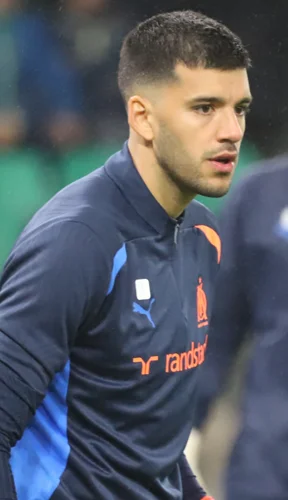 RulliMarseille0G0A29apps
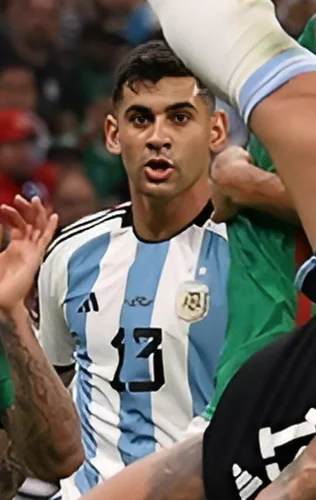 RomeroTottenham Hotspur4G1A24apps
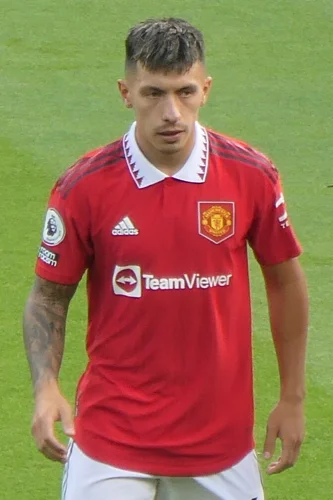 MartínezManchester United0G0A18apps
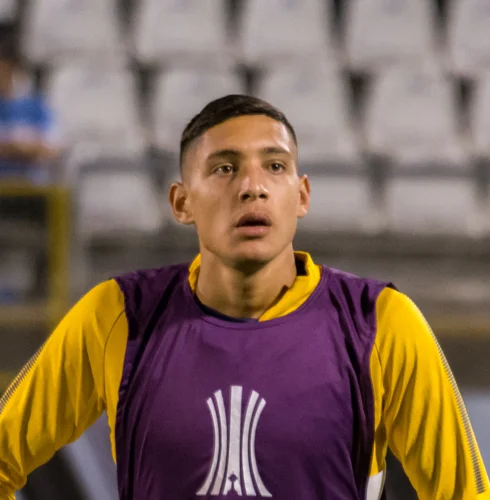 MolinaAtlético de Madrid2G2A26apps
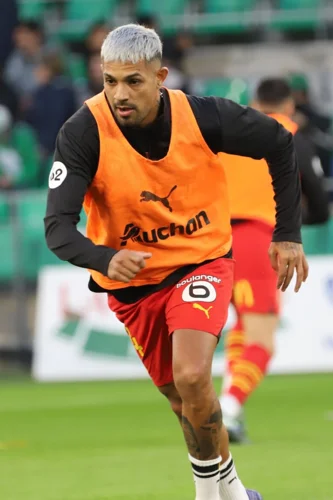 MedinaLens0G1A17apps
 PazComo12G6A35apps
 PaulInter Miami CF4G7A13apps
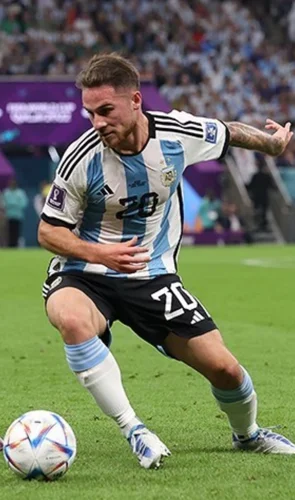 AllisterLiverpool2G4A37apps
 CelsoReal Betis2G3A24apps
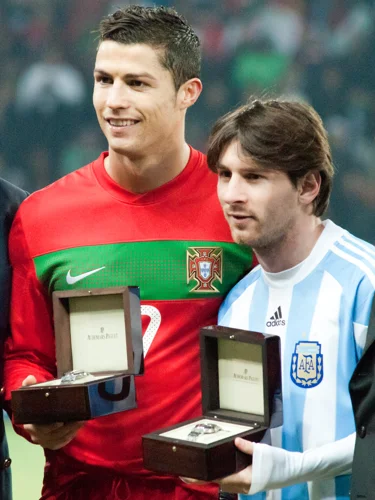 MessiInter Miami CF12G8A14apps
 ÁlvarezAtlético de Madrid8G4A29apps
Scaloni’s Argentina are a flexible 4-4-2 on paper that often morphs into a 4-3-3 in possession and a compact 4-4-2 without the ball.