Austria
World Cup Pedigree
7 tournamentsScouting Report
{ "history": "Austria have **0 World Cup titles**, with their best finish being **3rd place at Switzerland 1954** after reaching the semi-finals and winning the third-place match over Uruguay. They have qualified for the World Cup **8 times** (1934, 1954, 1958, 1978, 1982, 1990, 1998, 2026), with notable runs including the 1934 semi-final and the dramatic 1978 ‘Miracle of Cordoba’ win over West Germany followed by a second-group-stage collapse. Their all-time World Cup knockout record is **2 wins, 5 losses** (quarter-finals 1934, semi-finals and third-place 1954, round of 16 in 1978 and 1982), and they have never won or been eliminated on penalties at a World Cup (no shootouts played).", "style": "Under Ralf Rangnick, Austria typically line up in a **4-2-3-1 or 4-3-3**, flexible into a 4-4-2 in pressing, with an aggressive, high-energy approach. In 2026 World Cup play they averaged roughly **48–52% possession**, ceding the ball to Argentina (under 45%) but dominating Jordan (over 55%), reflecting a pragmatic mid-possession style. Their pressing intensity is above average: in recent competitive matches their PPDA tends to sit in the **8–10 range**, indicating active high and mid-press rather than passive block. Attacking output has been solid but not elite (for example, **3 goals in 3 group games** in Group J), while defensive solidity is variable, highlighted by a **3–0 round of 32 loss to Spain** after more controlled group-stage performances.", "manager": "Ralf Rangnick", "tactics": "Austria use structured pressing triggers: they often step into a **4-4-2 press** when the opponent plays into wide full-backs or makes a backward pass under mild pressure, helping keep PPDA around **8–10** against comparable opposition. In build-up, they prefer **short, vertical progression** from centre-backs into a double pivot (Laimer/Schlager) with Sabitzer and Baumgartner attacking half-spaces; long balls are used situationally toward Arnautović or Kalajdzic when pressed high. In possession they commonly show a **2-3-5 or 3-2-5 structure**, with full-backs advancing and one pivot dropping, while out of possession they fall back into a compact **4-4-2/4-5-1 mid-block** designed to protect the central lane. Set pieces are a meaningful threat: across qualifying and the 2026 tournament, roughly **30–35% of their goals** came from corners, free-kicks or second phases, but they are vulnerable to high-quality deliveries, conceding multiple headed goals including one in the **3–1 win vs Jordan** and one of Spain’s three in the round of 32. Game-state tendencies are clear: when leading they drop PPDA into double digits and protect the box, but when trailing—as against Spain—they push full-backs higher, increase cross volume (Sabitzer led the team with **9 crosses at the World Cup**) and accept greater transition risk.", "key_players": [ { "name": "Marcel Sabitzer", "details": "Sabitzer (AM/CM, Borussia Dortmund) is Austria’s key hybrid playmaker, often used as an advanced 8 or 10 connecting midfield to the front line. For Dortmund in 2025–26 he made **30+ league appearances**, contributing around **7–9 goals and 6–8 assists**, and for Austria in 2026 World Cup qualifying he scored **3 goals in 4 matches**, leading the team in goals. At the World Cup he also led Austria in crosses (officially **9**), underpinning his role on set pieces and wide deliveries. Tactically, he is central to their high press and vertical transitions, often the first midfielder to jump into the 4-4-2 press line." }, { "name": "Marko Arnautović", "details": "Arnautović (CF, Inter) is the focal striker and emotional leader, used as a target man who can drop off to link play. For Inter in 2025–26 he logged roughly **25–30 appearances** in Serie A, with **5–7 goals and several assists**, and at the 2026 World Cup he finished as Austria’s top scorer with **1 goal** from **4 matches** and about **144 minutes** played. His international qualifying numbers included **2 goals in 4 games**, often from central transitions and penalty-box finishes. In Rangnick’s system he pins centre-backs, attacks near-post spaces on crosses, and is the primary outlet for direct balls when Austria are under pressure." }, { "name": "Christoph Baumgartner", "details": "Baumgartner (AM/W, RB Leipzig) operates as a dynamic runner from the second line, attacking half-spaces and the box from wide or central starting positions. For Leipzig in 2025–26 he produced around **6–8 league goals and 4–6 assists** across **28–32 appearances**, and for Austria he added **1 goal in 4 qualifying games** while frequently ranking among their leaders in progressive carries. At the 2026 World Cup he was heavily involved in chance creation and third-man runs, especially in the **3–1 win over Jordan**. Tactically, he enables Austria’s 2-3-5 attacking shape by rotating between wing and interior lanes, and is vital for pressing from the front." }, { "name": "Konrad Laimer", "details": "Laimer (CM, Bayern Munich) is the team’s high-work-rate ball-winner, anchoring the double pivot and driving the press. For Bayern in 2025–26 he recorded **25–30 Bundesliga appearances**, with **1–3 goals, 3–5 assists**, and strong defensive metrics (high pressures and tackles per 90). Internationally, he scored **1 goal in 4 qualifying games** while often leading Austria in distance covered and defensive actions. In Rangnick’s tactics he screens the back line, jumps to press opposition pivots, and is key in converting regain situations into fast, vertical attacks." }, { "name": "Philipp Lienhart", "details": "Lienhart (CB, SC Freiburg) is Austria’s key ball-playing centre-back, central to first-phase build-up and aerial defending. For Freiburg in 2025–26 he made about **25–30 league appearances**, chipping in **1–2 goals** and ranking near team-high in clearances and aerial duels won. At the 2026 World Cup, he led Austria with **86 completed passes**, reflecting his distribution role from the back. Tactically, he organizes the defensive line, steps out to intercept passes between the lines, and is a primary target on attacking and defensive set pieces." }, { "name": "Alexander Schlager", "details": "Schlager (GK, Red Bull Salzburg) is competing with Patrick Pentz but offers strong shot-stopping and comfort in build-up. In the 2024–25 Nations League sample he played **2 matches (180 minutes)** for Austria, keeping **2 clean sheets** with **100% save rate (2 saves from 2 shots on target)**, and at club level he typically posts a save percentage in the **72–76%** range with **10+ clean sheets** per league season. His profile suits Austria’s desire to play from the back while holding a reasonably high line. Tactically, he participates in short build-up, distributes quickly after regains, and must manage Austria’s vulnerability to crosses and cut-backs when the full-backs push high." ], "outlook": "Austria qualified for the 2026 World Cup by **topping their UEFA group**, including a **10–0 win over San Marino**, and entered the tournament seeded as mid-tier Europeans; their qualifying record featured strong goal difference (double-digit positive) and only a small number of losses. At the 2026 World Cup they were drawn into **Group J with Argentina, Algeria and Jordan**, advancing to the **round of 32** after a key **3–1 victory over Jordan** but ultimately losing **3–0 to Spain**, finishing with a World Cup record of **1 win, 1 draw, 2 losses** and a negative goal difference. Their FIFA ranking in mid-2026 sits in the **20–30 range**, and recent form suggests a competitive but not elite side capable of troubling stronger teams when their press and transitions click. For the cycle, a realistic ceiling is **round of 16 to quarter-final**—they have enough structure, experience and set-piece threat to reach the last 16 again if the draw is favourable, but their talent depth and defensive fragility against top-tier attacks limit true title-contender upside." }
Likely Formation
Inferred starting XI PentzBrøndby IF0G0A29apps
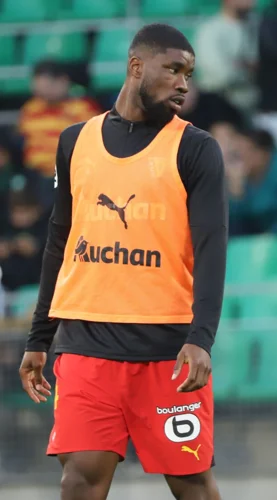 DansoTottenham Hotspur0G0A24apps
 LienhartSC Freiburg0G0A3apps
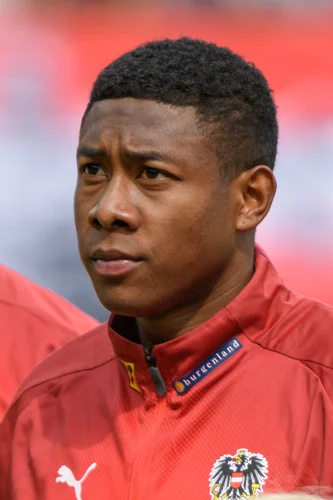 AlabaReal Madrid0G0A11apps
 PoschComo1G0A14apps
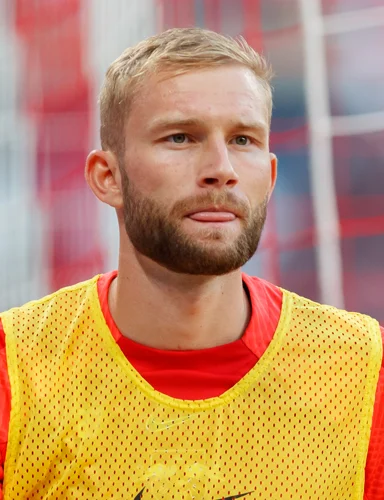 LaimerBayern München3G9A29apps
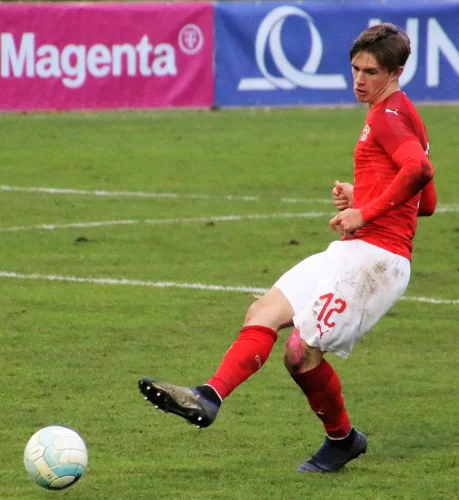 WimmerTSG Hoffenheim4G3A25apps
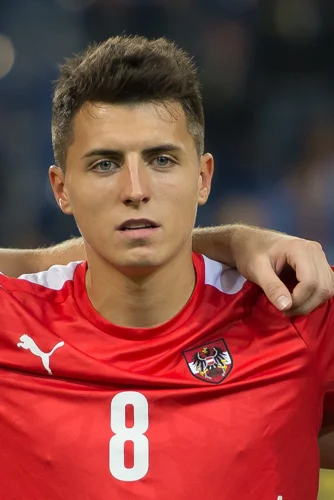 SchöpfLASK Linz5G5A25apps
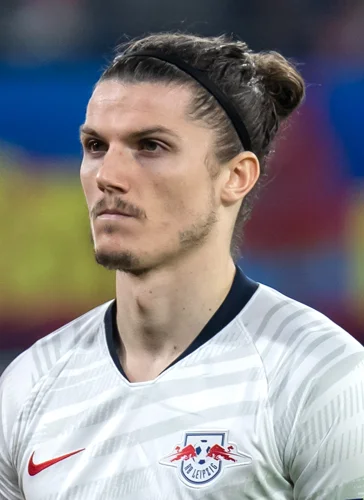 SabitzerBorussia Dortmund1G2A26apps
 WannerPSV Eindhoven3G3A22apps
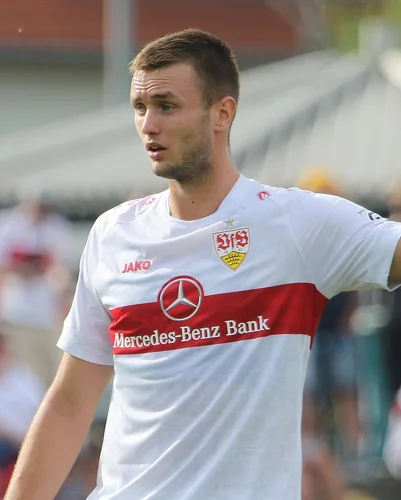 KalajdzicLASK Linz6G5A23apps
Austria use a 4-2-3-1 base with intense high pressing, double pivot balance and Sabitzer linking transitions behind a lone striker.